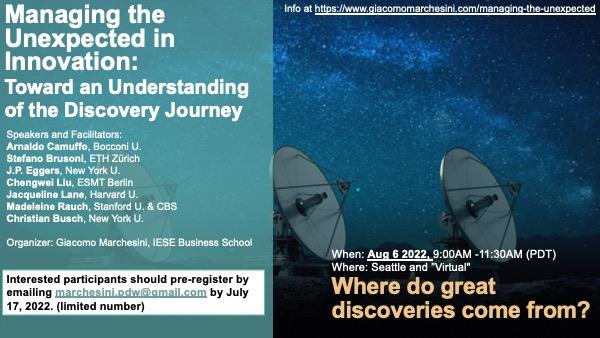
I'll be hosting a Professional Development Workshop (PDW) titled "Managing the Unexpected in Innovation: Toward an Understanding of the Discovery Journey" at the upcoming AOM Annual Meeting (both in-person and virtually).
The workshop will bring together a diverse array of perspectives, such as scientists' and inventors' cognition and decision-making, how organizations learn from failure and serendipitous events, and how fault-tolerant and incidental learning can help face societal grand challenges. The goal is to improve our understanding of how discovery processes might deviate from traditional learning and decision-making theories and how to manage and capture value from unexpected adverse and positive events (i.e., innovation failures and serendipitous results).
In the first part (panel, open to everyone), an inspiring group of seven leading scholars – Arnaldo Camuffo, Stefano Brusoni, J.P. Eggers, Chengwei Liu, Jacqueline Lane, Madeleine Rauch, and Christian Busch – will introduce different topic areas and present the future of the research, sharing their experience working in the field and clarifying the boundaries between what we know and what we do not. In the second part (pre-registration required), participants will be accommodated in an interactive roundtable format ("research incubator") chaired by each of the seven invited speakers and aimed at nurturing early-stage ideas and research projects.
Interested participants should pre-register by emailing marchesini.pdw@gmail.com by July 17, 2022. Given we accept only a limited number of participants for the second part, we encourage early registrations. Please feel free to contact me in case you have any questions.
Title: Managing the Unexpected in Innovation: Toward an Understanding of the Discovery Journey
When: Aug 6 2022 from 9:00AM to 11:30AM (Seattle time)
Speakers and Facilitators:
- Arnaldo Camuffo, Bocconi U.
- Stefano Brusoni, ETH Zürich
- J.P. Eggers, New York U.
- Chengwei Liu, ESMT Berlin (attending Virtual)
- Jacqueline Lane, Harvard U.
- Madeleine Stefanie Rauch, Stanford U. & Copenhagen Business School
- Christian Busch, New York U.
Organizer: Giacomo Marchesini, IESE Business School
About the topic:
Unexpected events are intrinsic components of innovative activities, processes that, by their idiosyncratic nature, have likelihoods that are impossible to foresee.
Scientific creativity is associated with search processes that are "ill-defined" (Klahr and Dunbar 1988), with the initial state poorly specified, and the goals ambiguous. Many great ideas, scientific discoveries, and game-changing inventions happen thanks to unplanned events like fortuitous coincidences or multiple failed attempts. Yet, exactly because they are not easy to plan or foretell, most management literature assumes these events should be avoided or limited. For instance, failures tend to be considered errors or mistakes, whereas there are contexts where they can be valuable. Similarly, serendipity and uncertainty are constantly minimized, yet they are integral parts of how individuals search, learn, memorize, and forge the structures of novel ideas.
This PDW aims to advance the debate on how organizations can better manage and capture value from unexpected events when they are supposed to be embraced rather than avoided if we want to accomplish breakthrough ideas that can benefit society. Specifically, this workshop focuses on two key domains: innovation failures (i.e., managing and capturing value from unexpected adverse events) and serendipity (i.e., managing and capturing value from unexpected positive events).
The first part (the panel session) is open to all. The second part of the workshop (60 min) will be open to pre-registered participants only (limited numbers). Participants will be allocated to roundtables ("research incubators") before the event based on their expressed preference, profile, research interests, proposed inputs, and order of registration. Each research incubator will be chaired by one or more invited speakers and will cover a specific topic area. There will be the possibility for one "virtual" roundtable based on expressed preferences.
Each research incubator will include one (or more) of the following activities: (1) ideas generation, providing opportunities for brainstorming; (2) ideas validation, discussing, assessing, and collecting feedback from proposed ideas; (3) ideas implementation, finding potential co-authorship opportunities, validating methodologies, and boosting the development of research projects.
Registration emails should include the following information:
(i) name, affiliation, and current position;
(ii) one facilitator/topic area preference;
(iii) research interests and/or reasons why interested in the workshop, including types of inputs planning to bring. Examples of inputs that participants can bring to the research incubator are (but are not limited to): a research project currently under development; an early-stage research project idea to engage in preliminary debates; competencies and expertise; a proposal of data or novel methodological approaches; a set of well-defined research questions.